
Schools are frequently pressured to improve every operational and academic facet simultaneously, from raising standardized achievement and strengthening classroom instruction to boosting attendance, increasing student engagement, mitigating unfinished learning, and reinforcing behavior systems. At the same time, leaders are urged to do so much more, like potentially overhaul curriculum, enhance data literacy, cultivate teacher leadership, and deepen family partnerships. While each priority holds genuine merit, attempting to tackle all of them at once ensures that none becomes the organizing priority. In her July–August 2026 Harvard Business Review article, “The Power of Strategic Centering,” Rita McGrath argues that organizations navigate uncertainty and execute far more effectively when they anchor their decisions and actions to a singular, clear organizing principle (McGrath, 2026). This concept carries profound implications for educational systems: rather than demanding that educators overhaul ten distinct practices at once, leadership can identify a single, high-leverage instructional focus that serves as the central anchor for professional learning, instructional coaching, peer collaboration, walkthrough feedback, and systemic decision-making. Far from merely trimming an initiative list, this approach establishes strategic centering for instructional improvement, functioning alongside collective efficacy and disciplined organizational theories to build genuine collective capacity rather than surface-level compliance. To put it simply, go deeper with the learning and not broader.
A persistent barrier to sustainable school improvement is the continuous accumulation of disconnected initiatives, where focus ping-pongs from student discourse to data-driven instruction, followed in successive years by curriculum adoption, differentiation, culturally responsive pedagogy, and targeted intervention. Because old initiatives rarely sunset before new mandates arrive, teachers are left overwhelmed and unsure of what specific pedagogical shifts to make tomorrow. At best, they reach mediocrity with each wave of initiatives. Strategic centering replaces this fragmentation by identifying the single instructional practice that holds the greatest potential to elevate student learning and unlock broader organizational capacity such as engaging all learners in rigorous grade-level standards through purposeful questioning. Another could be engaging students in deep discourse and the structured use of student thinking. Rather than sidelining areas like classroom culture or intervention, centering uses this primary instructional problem to filter every secondary decision, bringing cohesive alignment to the entire school community. Alignment gives a throughline of learning and a clear path to success.
Let’s get clear about the difference between an initiative and an instructional focus. An initiative is merely something a school implements, whereas an instructional focus is an enduring capability an organization deliberately builds. While implementing a new curriculum emphasizes operational execution, cultivating teachers’ ability to leverage curriculum tasks and student discourse to foster critical thinking builds sustainable capacity. This reframing transforms professional development from one-off or disconnected workshops into an ongoing cyclical cadence of learning, applying, observing, analyzing, adjusting, and reapplying around a common instructional thread.
This continuous cycle forms the foundation of Albert Bandura’s work on collective efficacy, which represents a faculty’s shared, unified belief in their joint capability to organize and execute courses of action that yield positive student outcomes (Bandura, 2000). Seminal research confirms the profound impact of this shared mindset; Hoy, Sweetland, and Smith positioned collective efficacy as an integral pillar within an organizational model of high-school student achievement (Goddard et. al., 2000), while Hattie demonstrated that strong collective teacher efficacy directly enhances student learning outcomes across schools (Waack, 2018). Professional development must therefore move beyond isolated individual teacher knowledge to deliberately cultivate the belief that the team can collectively solve instructional challenges. Because collective efficacy expands primarily through mastery experiences, educators must move beyond passive training to actively analyze student artifacts, rehearse targeted pedagogy, test instructional moves in classrooms, get feedback, potentially examine student responses, and iteratively refine their craft until shared success cements the mindset that they can succeed together. The alignment to the focus taps into the collective efficacy as teachers inevitably see success especially through the resilience of the group.
When an entire school organizes around a single shared goal such as ensuring every classroom consistently engages students in explaining, representing, and defending their thinking, the instructional focus becomes the school’s central learning engine. Professional development equips staff with explicit questioning and discussion strategies, while instructional coaches target their walkthroughs and feedback specifically on the teacher moves that engage students in critical thinking and engagement with student deep engagement as one of their metrics of success. Within professional learning communities, teams examine lesson plans for opportunities to improve questioning and successfully host a discussion, while leaders align formal observations, scheduling, curriculum planning, and diagnostic assessments to support that specific practice. Consequently, professional learning, coaching, curriculum implementation, and data analysis cease to operate as competing silos, merging instead into an integrated, coherent instructional strategy. The initiatives align to the focus providing multiple layers for teachers to see success and feel successful.
Nevertheless, clarity alone cannot drive sustainable transformation without a sound organizational theory of change. John Kotter’s change framework highlights that meaningful progress requires establishing urgency, forming a guiding coalition, articulating a clear vision, mobilizing stakeholders, removing institutional barriers, generating short-term wins, and institutionalizing new practices (Kotter International Inc., n.d.). To make a focus take root, school leadership must articulate why the targeted priority matters, demonstrate what it looks like in live practice (set clear expectations of success), and provide scaffolded support (professional development plan) so it is embraced as a shared improvement opportunity rather than a mandate.
Complementing this approach, Kolb and Frohman’s (1970) planned-change model emphasizes the critical role of relationship building, systemic entry, diagnostic inquiry, collaborative action planning, and continuous feedback loops before prescribing interventions. Rather than reacting to disengagement with immediate, generic workshops, leaders must first investigate classroom realities, analyze student work, examine walkthrough data, and incorporate teacher perspectives to diagnose underlying causes. It is critical to identify the learning gap between what teachers know and what the vision is of the learning. This diagnostic rigor builds widespread faculty ownership, as staff are far more invested in change when they clearly understand the problem, see the rationale, and help shape the response. As shown in the image below, they are more willing to invest back into the organization when the learning is purposeful, helpful to their success, and they actually see the results.
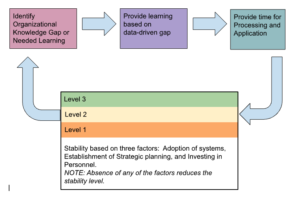
Note: The stability factors potentially prohibit the ability to build a learning community based on the idea of cognitive overload for staff when they are distracted by non-instructional issues such as where to make copies, how to fill out insurance preference, who to ask for help, etc..
To sustain this momentum over the long term, Noel Tichy and Mary Anne Devanna’s transformational leadership framework (1986) outlines three vital acts: recognizing the need for revitalization, creating a compelling shared vision, and institutionalizing organizational change. In the initial stage, schools analyze observational trends and student work without assigning blame, isolating the central instructional challenge that warrants collective focus. Leaders then translate that need into a clear vision of effective daily instruction, giving teachers a concrete destination. Finally, the transformation is institutionalized by embedding the instructional focus permanently into professional learning community agendas, coaching protocols, observation rubrics, and leadership meetings until it becomes the baseline standard for how the school operates.
Ultimately, the primary responsibility of school leadership is to actively protect this instructional center against the constant pull of urgent, competing demands. When new mandates, assessments, or district initiatives emerge, leaders must evaluate them through the lens of their strategic center, discerning how incoming resources can strengthen the core priority rather than divert energy away from it. By grounding this commitment in an explicit theory of action, linking leadership actions to teacher learning, collective efficacy, instructional refinement, student engagement, and elevated achievement, schools establish measurable indicators of success that connect professional learning directly to student impact.
Lasting school transformation is not about doing more; it is about doing the right thing with depth and purpose. By shifting from the exhausting cycle of disconnected initiatives to a model of strategic centering, school leaders can create a coherent path for improvement. This requires moving beyond surface-level compliance to build a shared, enduring capacity among staff.
To begin this journey, consider these recommended steps:
- Identify Your Anchor: Pinpoint the single, high-leverage instructional focus such as deeper student discourse or purposeful questioning. It should hold the greatest potential to elevate student learning.
- Align the Engine: Generate a professional development with a goal of making everyone proficient at the instructional focus. From there, conduct a learning gap analysis that ensures the coaching protocols, meetings, and feedback specifically aligns to this focus, ensuring these systems no longer operate as competing silos.
- Build Collective Efficacy: Create opportunities for teams (i.e. department meetings, grade level meetings, whole staff meetings, etc.) to analyze data and/or student work aligned to the intended impact of the focus, rehearse pedagogy, and refine their craft together. This shared commitment to solving challenges strengthens the team’s belief in their collective ability to achieve the instructional vision.
- Protect the Focus: Evaluate all new mandates and initiatives through the lens of your strategic center, prioritizing those that strengthen your core goal and filtering out distractions.
Remember, the true power of this approach lies in the unity it creates. When educators are aligned, supported, and given the time to master a single, essential goal, the result is more than just academic improvement; it is the development of a resilient, effective school community capable of achieving anything. Let’s stop chasing the next mandate and start deepening the learning that truly matters.
Lead to Empower has worked with many schools to identify an instructional focus and build out a strategy plan to achieve the instructional vision. Contact us if this issupport you may need.
Ahmadi, H. (2026, January 2). Kotter change management: How to apply the 8 steps successfully. ITSM.tools. https://itsm.tools/kotter-change-management/
Bandura, Albert. “Exercise of Human Agency through Collective Efficacy.” Current Directions in Psychological Science, 2000, doi:10.1111/1467-8721.00064. Accessed 15 Nov. 2025.
Goddard, R. D., Hoy, W. K., & Hoy, A. W. (2000). Collective teacher efficacy: Its meaning, measure, and impact on student achievement. American Educational Research Journal, 37(2), 479–507. https://doi.org/10.3102/00028312037002479
Kolb, D. A., & Frohman, A. L. (1970). Organizational development through planned change: A model for change agents. Sloan Management Review, 12(1), 51–60.
Kotter International Inc. (n.d.). Consulting. https://www.kotterinc.com/services/
McGrath, R. (2026). The power of strategic centering. Harvard Business Review, 104(4). https://hbr.org/2026/07/the-power-of-strategic-centering
Tichy, N. M., & Devanna, M. A. (1986). The transformational leader. John Wiley & Sons.
University of San Diego, Division of Professional and Continuing Education. (2026). The importance of collective efficacy in education. University of San Diego. https://pce.sandiego.edu/collective-teacher-efficacy/
Waack, S. (2018, March 7). Collective teacher efficacy (CTE) according to John Hattie. Visible Learning. https://visible-learning.org/2018/03/collective-teacher-efficacy-hattie/